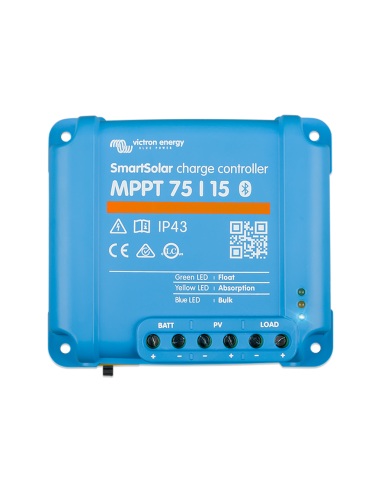
Victron SmartSolar MPPT Solar Charge Controller
Features:
- Maximum Power Point Tracking Solar Charge Controller
- Built-in Bluetooth for Ease of Programming & Monitoring
- 75V / 15A, Suitable for 12/24V Systems
- Internal Temperature Sensor
- Direct Communication Port for Wired Data Connection
- Over-Temperature Sensor
- Flexible Charge Algorithm
- Additional SmartSolar LCD Display Available
A solar charger gathers energy from your solar panels and stores it in your batteries. Using the latest, fastest technology, SmartSolar maximises this energy harvest, driving it intelligently to achieve full charge in the shortest possible time. SmartSolar maintains battery health, extending its life.
PWM and MPPT charge controllers are both widely used to charge batteries with solar power. The PWM controller is in essence a switch that connects a solar array to the battery. The result is that the voltage of the array will be pulled down to near that of the battery. The MPPT controller is more sophisticated (and more expensive): it will adjust its input voltage to harvest the maximum power from the solar array and then transform this power to supply the varying voltage requirement of the battery plus load. Thus, it essentially decouples the array and battery voltages so that there can be, for example, a 12V battery on one side of the MPPT charge controller and panels wired in series to produce 36 volts on the other.
It is generally accepted that MPPT will outperform PWM in a cold to temperate climate, while both controllers will show approximately the same performance in a subtropical to tropical climate. Besides performing the function of a basic controller, an MPPT controller also includes a DC to DC voltage converter, converting the voltage of the array to that required by the batteries, with very little loss of power.
An MPPT controller attempts to harvest power from the array near its Maximum Power Point, whilst supplying the varying voltage requirements of the battery plus load. Thus, it essentially decouples the array and battery voltages, so that there can be a 12V battery on one side of the MPPT charge controller and two 12V panels wired in series to produce 36 volts on the other. If connected to a PV array with a substantially higher nominal voltage than the battery voltage, an MPPT controller will therefore provide charge current even at very high cell temperatures or in low irradiance conditions when a PWM controller would not help much.
As array size increases, both cabling cross-sectional area and cable length will increase. The option to wire more panels in series and thereby decrease current is a compelling reason to install an MPPT controller as soon as the array power exceeds a few hundred Watts (12V battery), or several 100 Watts (24V or 48V battery).
More Product Features:
- Bluetooth Smart Built-in (No Dongle Needed): The wireless solution to set up, monitor and update the controller using Apple and Android smartphones, tablets or other devices.
- VE.Direct: For a wired data connection to a Color Control panel, PC or other devices.
- Ultra-fast Maximum Power Point Tracking (MPPT): Especially in the case of a clouded sky, when light intensity is changing continuously, an ultra-fast MPPT controller will improve energy harvest by up to 30% compared to PWM charge controllers and by up to 10% compared to slower MPPT controllers.
- Load Output: Over-discharge of the battery can be prevented by connecting all loads to the load output. The load output will disconnect the load when the battery has been discharged to a pre-set voltage (48V model: interface with a relay). Alternatively, an intelligent battery management algorithm can be chosen: see Battery Life. The load output is short-circuit proof.
- Battery Life - Intelligent Battery Management: When a solar charge controller is not able to recharge the battery to its full capacity within one day, the result is often that the battery will continually be cycled between a ‘partially charged’ state and the ‘end of discharge’ state. This mode of operation (no regular full recharge) will destroy a lead-acid battery within weeks or months. The Battery Life algorithm will monitor the state of charge of the battery and, if needed, day by day slightly increase the load disconnect level (i.e. disconnect the load earlier) until the harvested solar energy is sufficient to recharge the battery to nearly the full 100%. From that point onwards the load disconnect level will be modulated so that a nearly 100% recharge is achieved about once every week.
- Programmable Battery Charge Algorithm: See the software section on the Victron website for details.
- Programming, Real-time Data and History Display Options: Modern Apple and Android smartphones, tablets, MacBooks and other devices: see the VE.Direct Bluetooth Smart dongle and the MPPT app discovery sheet for screenshots.
Applications
- Marine
- RV
- Caravans
- Off-Grid Systems
- Tiny Houses
- Cabins
More about Victron:
Victron Energy has a strong, unrivalled reputation for technical innovation, reliability, and build quality. Their products are widely considered to be a professional choice for independent electric power. Efficiently combining two or more distinct power sources is what they do best. Their products include sinewave inverters, sinewave inverters/chargers, battery chargers, DC/DC converters, transfer switches, battery monitors and more.