TP-Link · Omada · Unmanaged
Sixteen gigabit ports, one rack unit.
Fanless and plug and play.
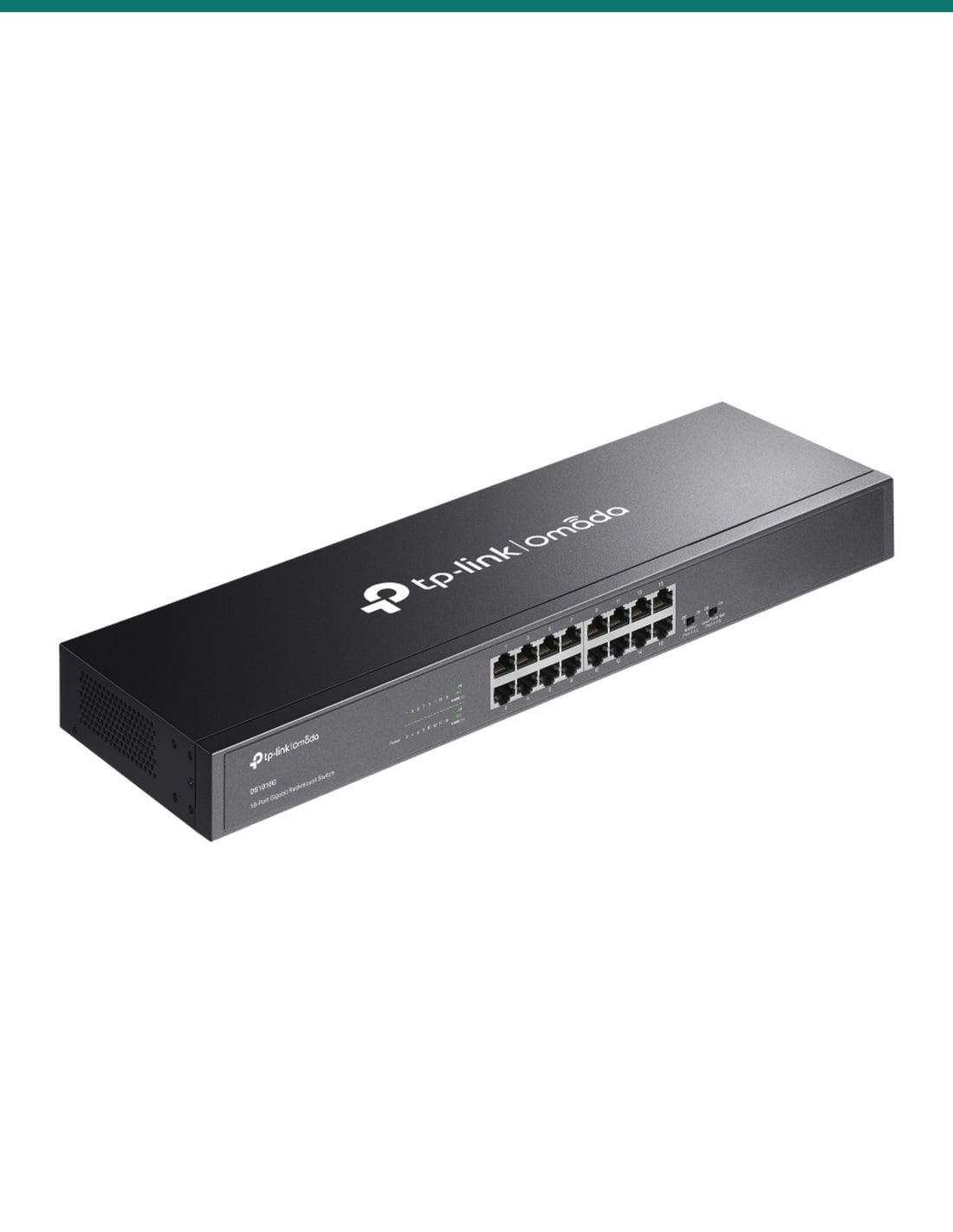
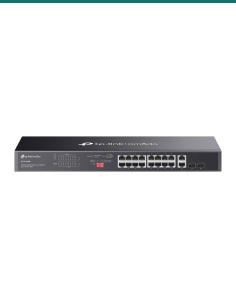
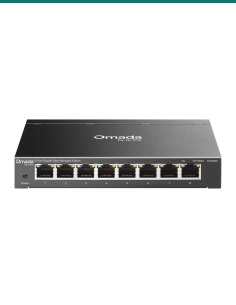
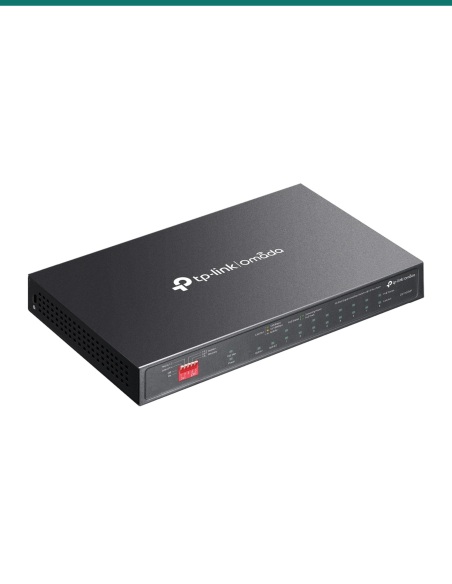
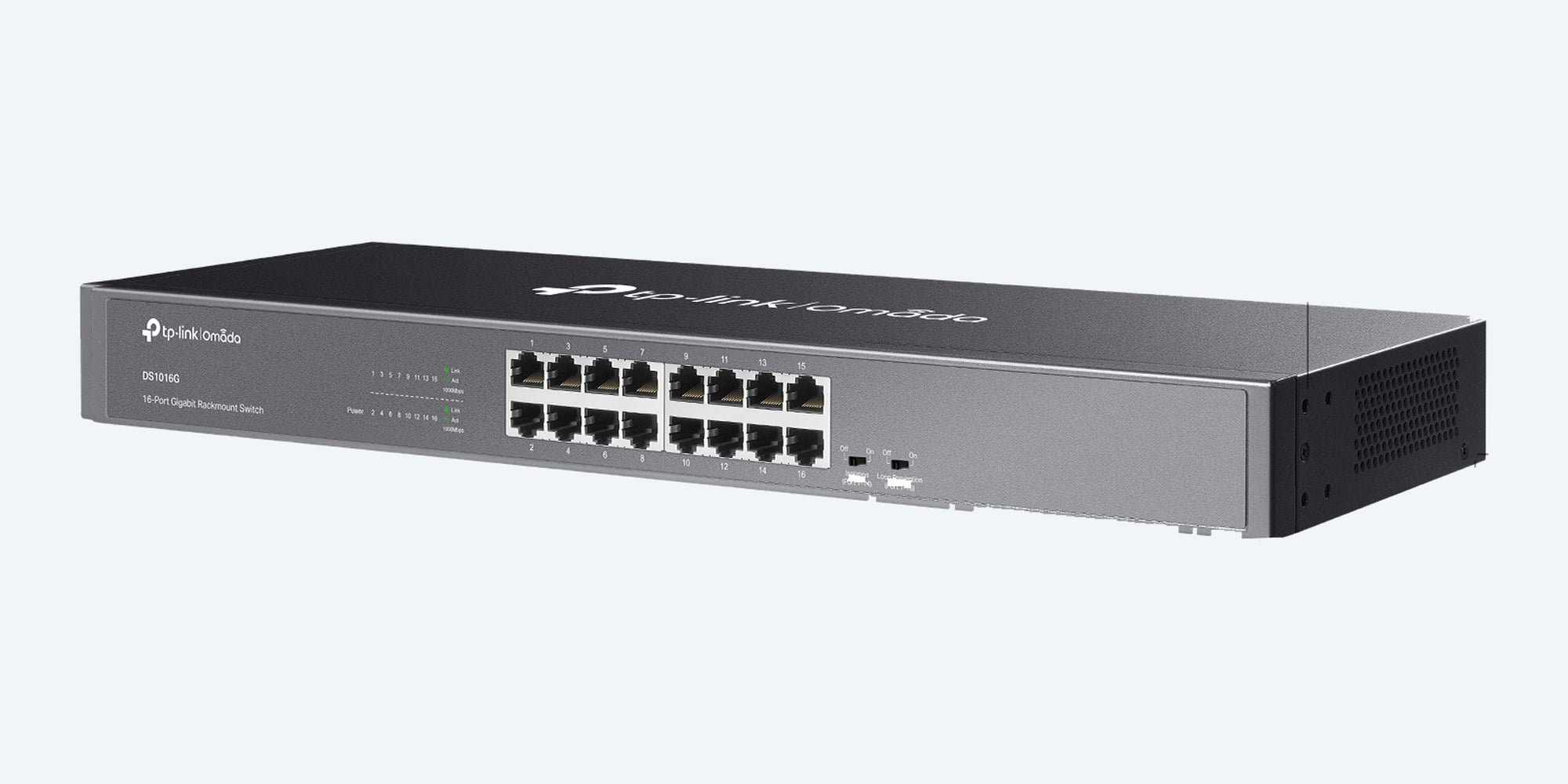
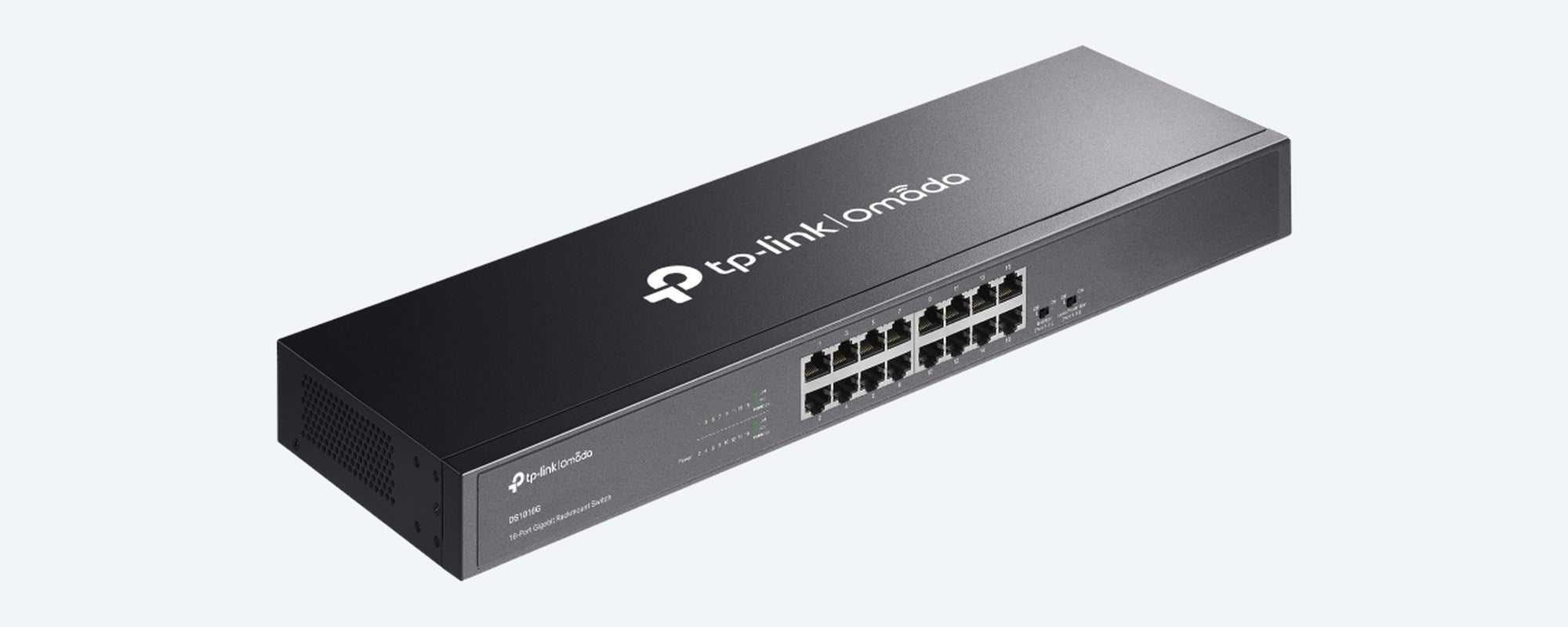
The DS1016G is a silent 19-inch rackmount switch with 16 gigabit ports, a built-in power supply and two front switches for port isolation and loop prevention.
In one sentence: the TP-Link Omada DS1016G is a fanless 16-port unmanaged gigabit rackmount switch with 32 Gbps switching capacity, Isolation mode, Loop Prevention, 802.1p/DSCP QoS and a built-in 100–240 V AC power supply in a 19-inch steel case.
Switch only. Patch leads and the devices you connect are separate.
This switch has no PoE: it does not power cameras or access points. The power supply is built in.
In the box- DS1016G switch
- Power cord
- Rackmount kit
- Rubber feet
- Installation guide
You also need- Cat5e or Cat6 patch leads
- Rack screws to suit your cabinet (not included)
- A PoE switch or injectors if your devices need power over the cable
More gigabit ports for the comms cabinet, with no fan noise.
Plug it in and every port runs at up to 1000 Mbps with auto MDI/MDIX, so any patch lead works. Isolation mode keeps ports 1 to 14 apart while they still reach ports 15 and 16, and Loop Prevention looks for a cable plugged back into the network by mistake.
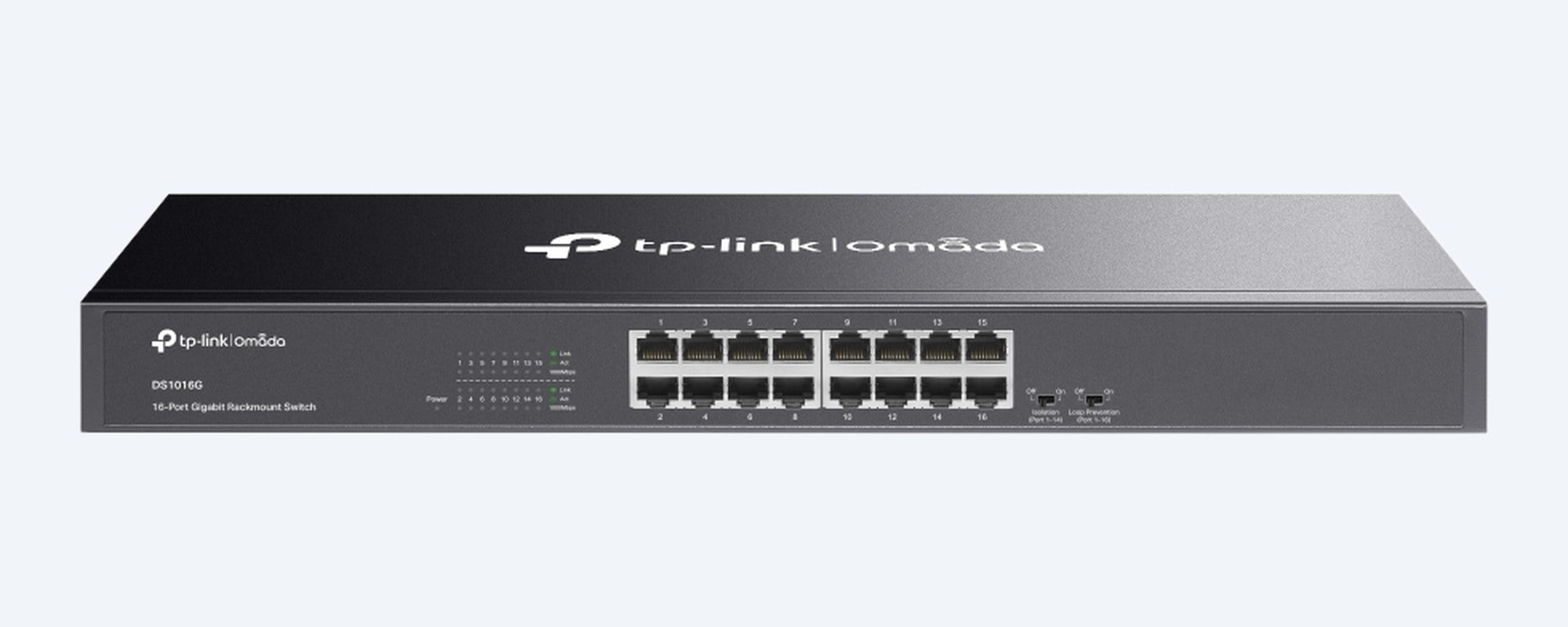
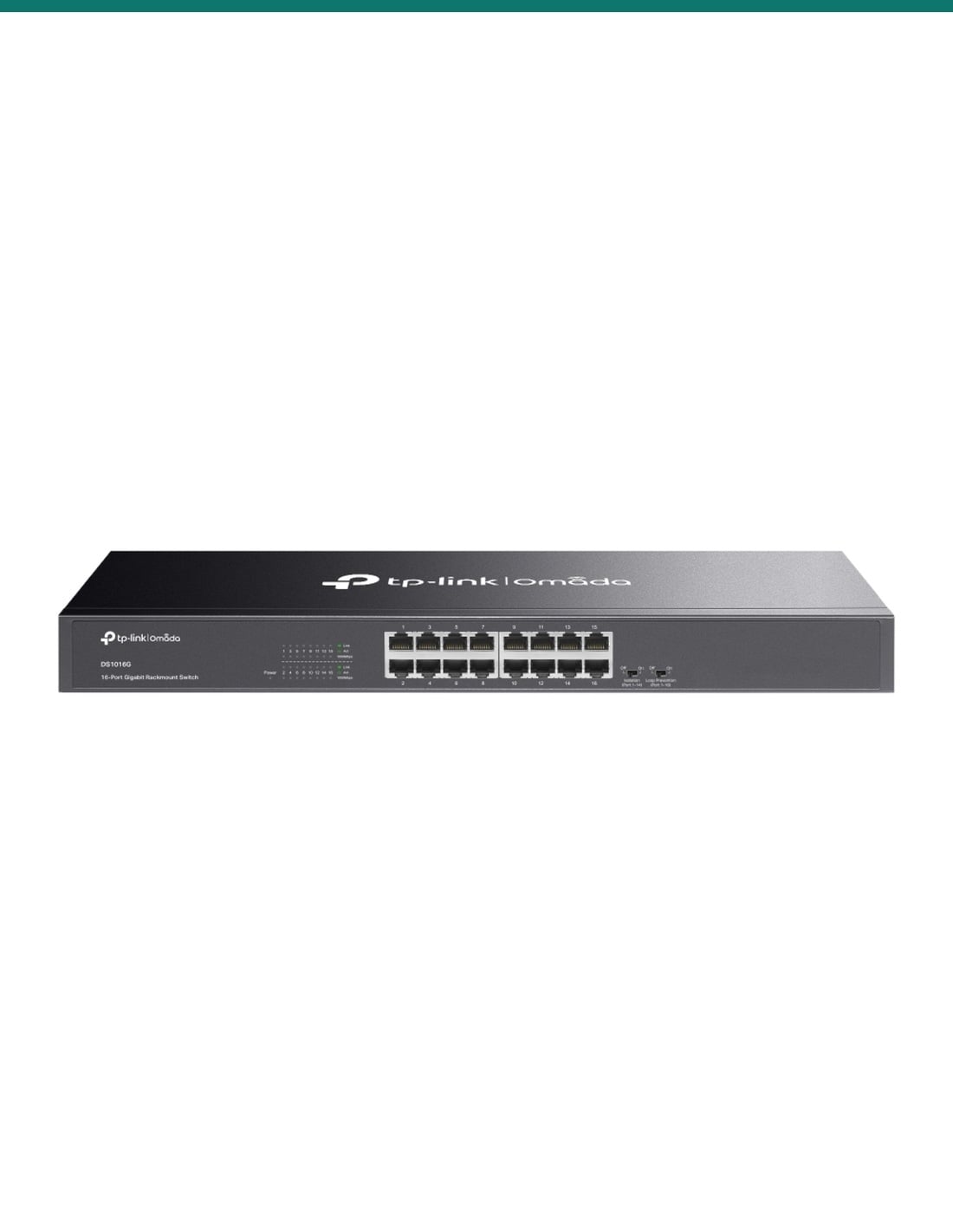
Front panel
16 gigabit ports and two switches.
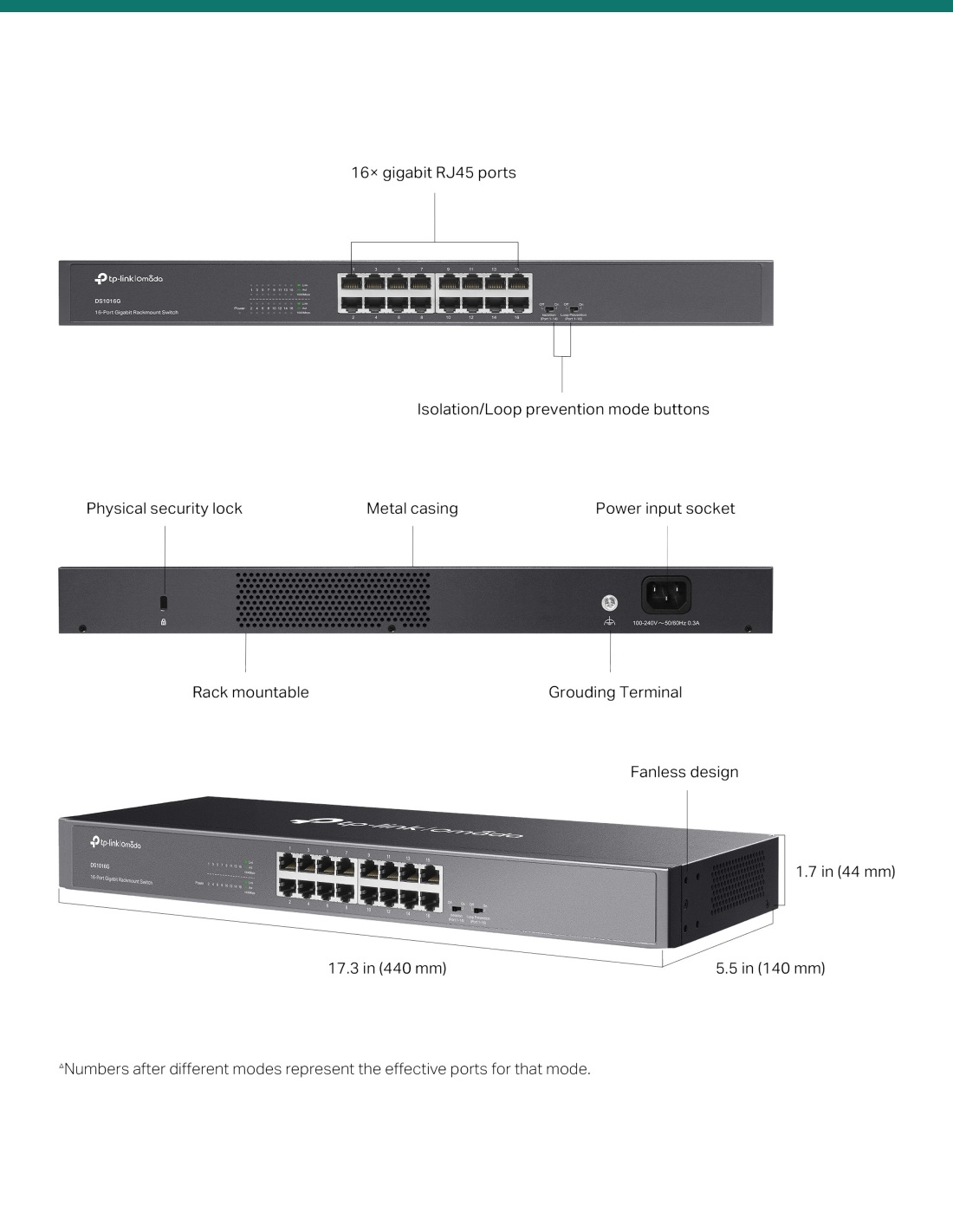
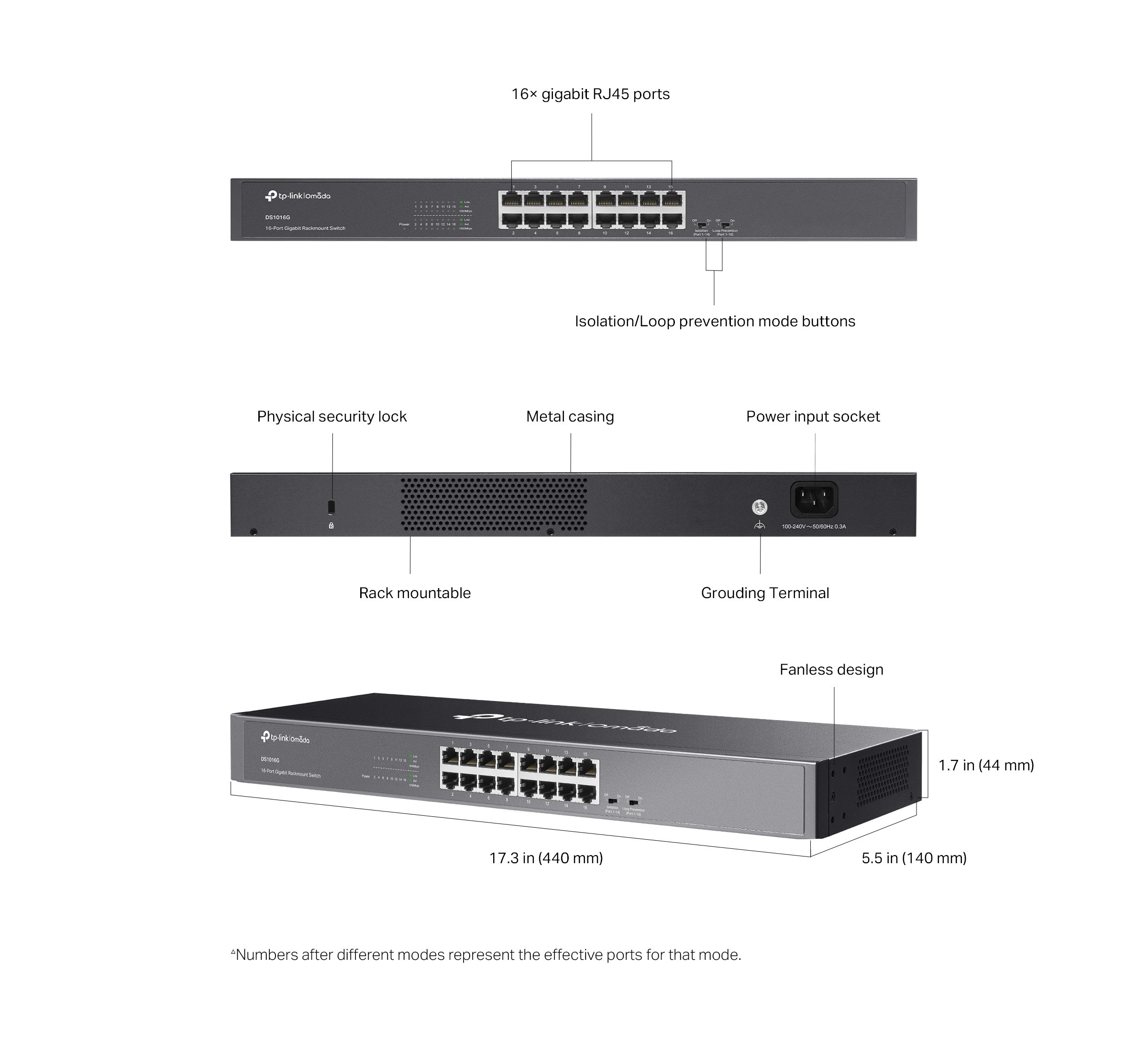
Ports 1 to 16 are 10/100/1000 Mbps RJ45. On the right, one switch turns on Isolation (ports 1 to 14) and the other turns on Loop Prevention (ports 1 to 16). The lights show power, link and speed for each port.
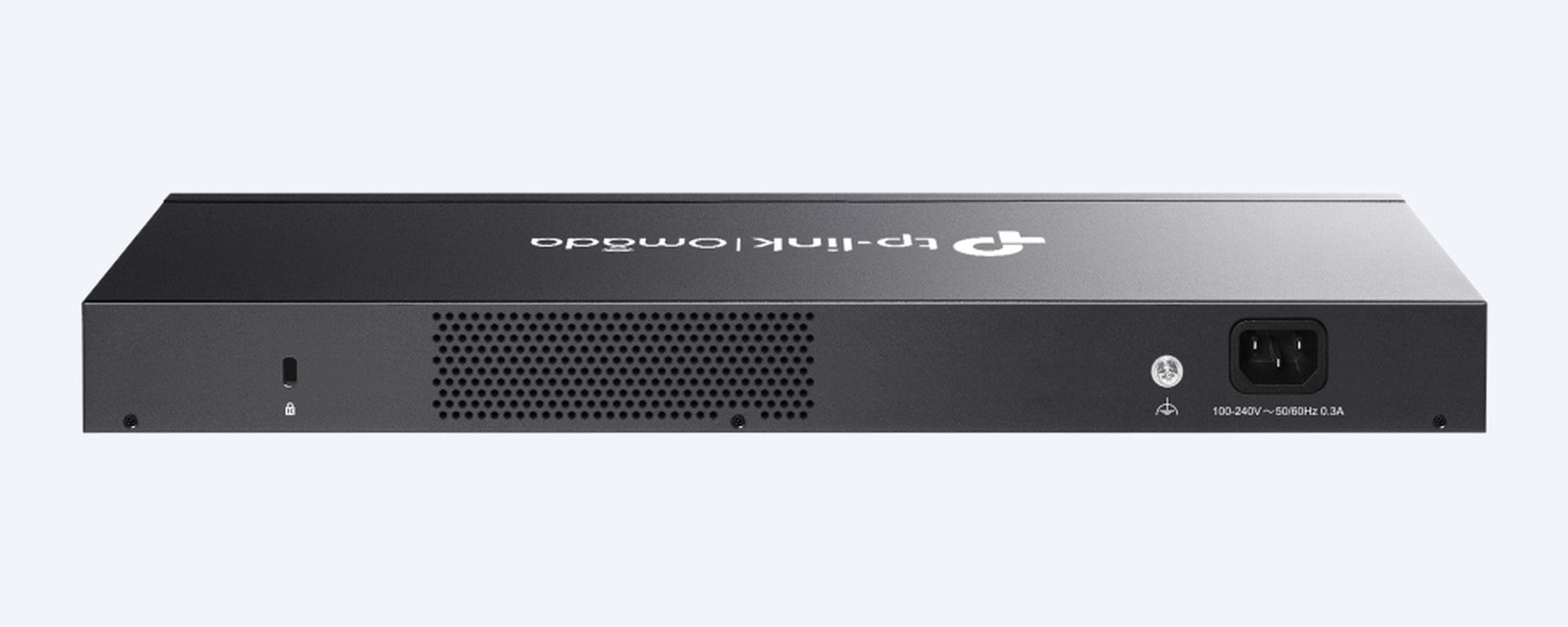
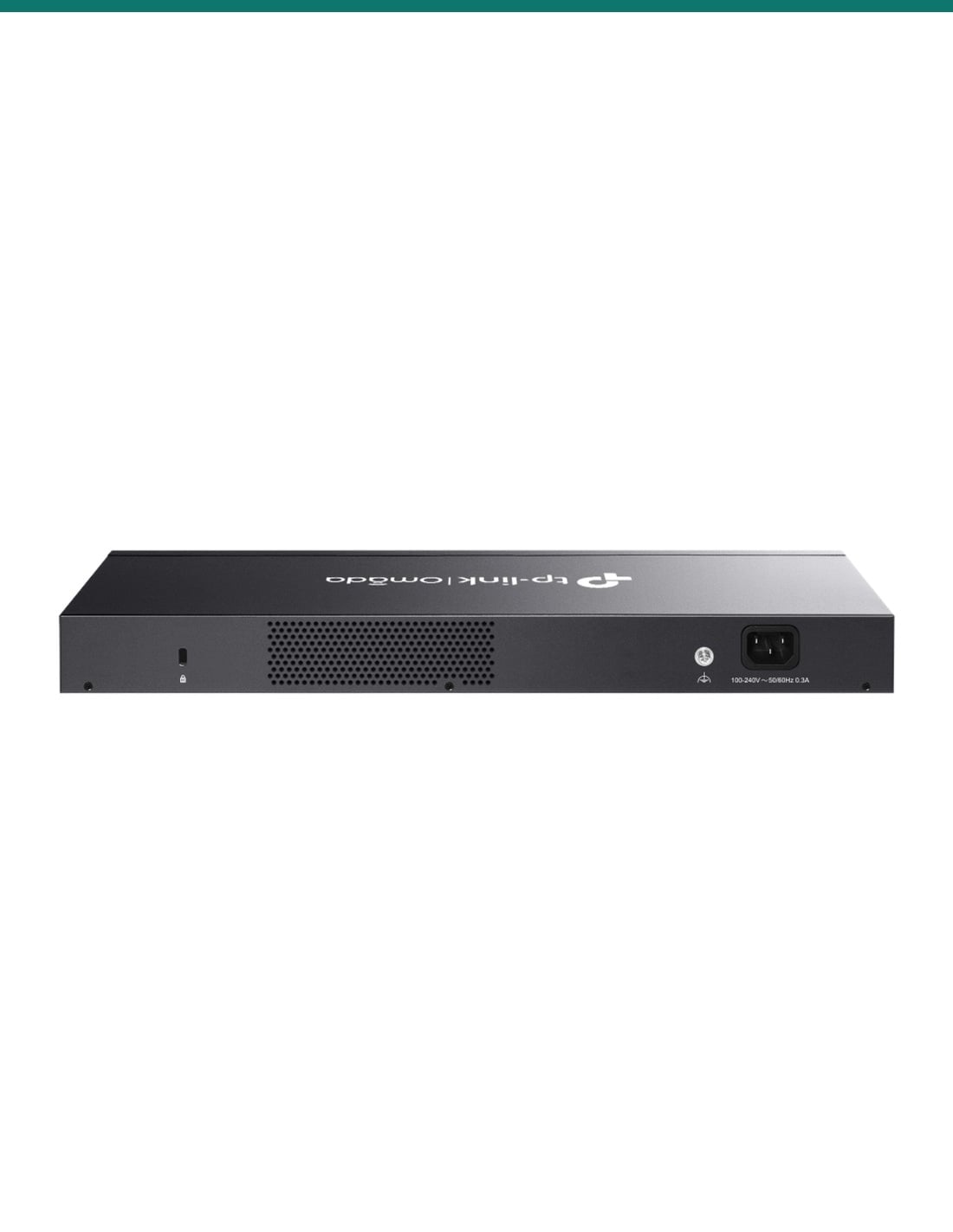
Rear panel
Built-in power, no fan.
A standard AC socket for the supplied cord (100–240 V, 50/60 Hz), a grounding terminal and a Kensington security slot. The steel case is fanless, so the switch is silent.
Chassis
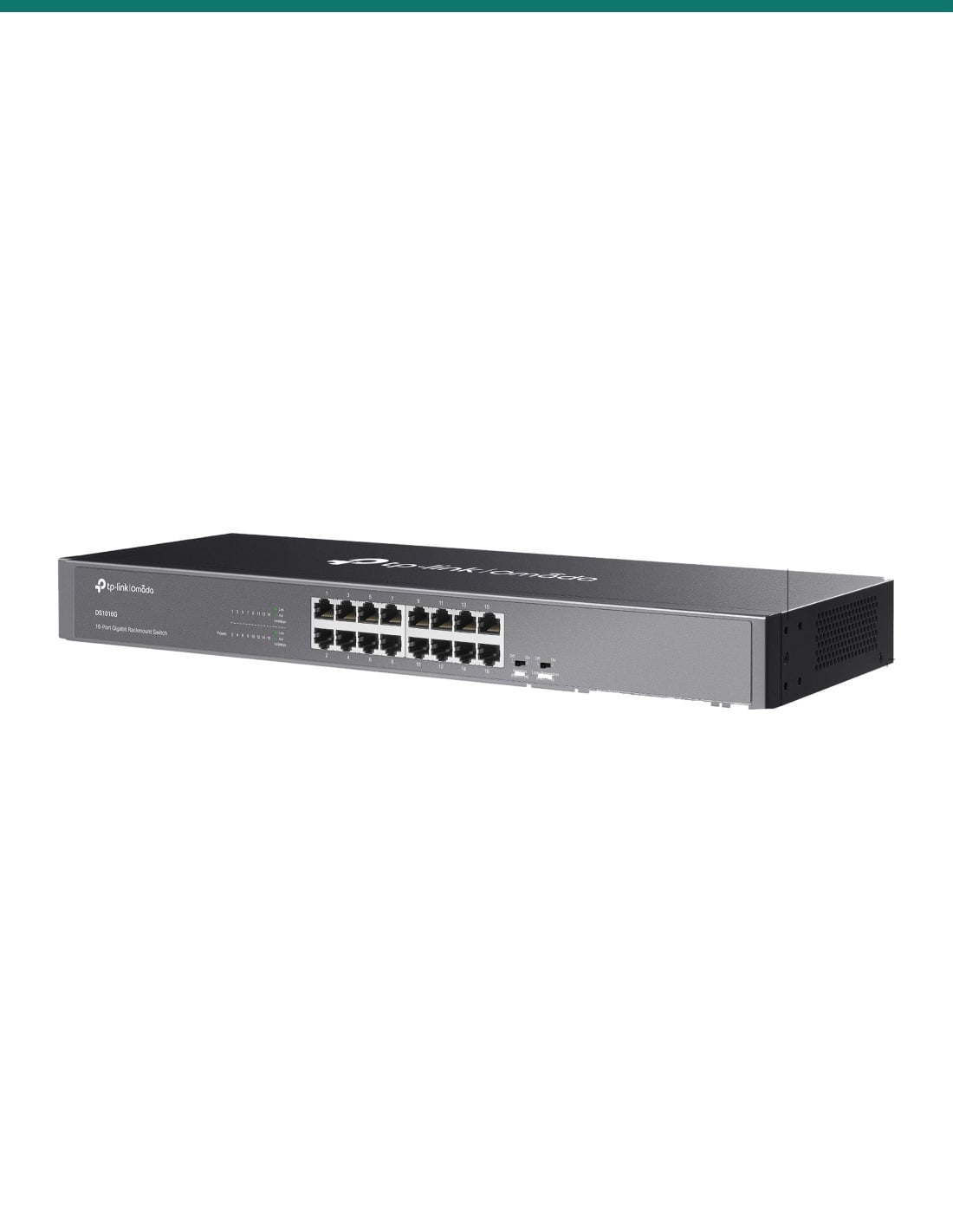
1U steel case, desk or rack.
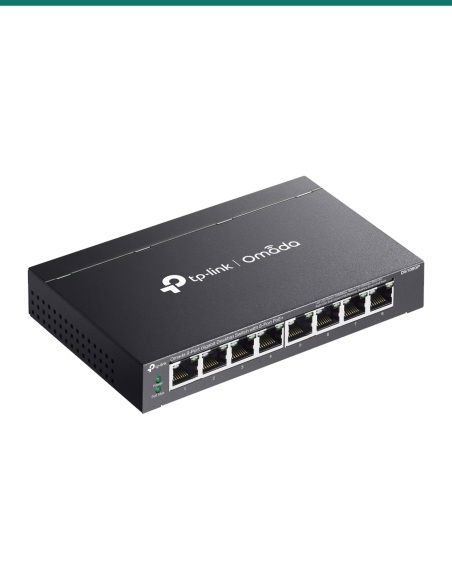
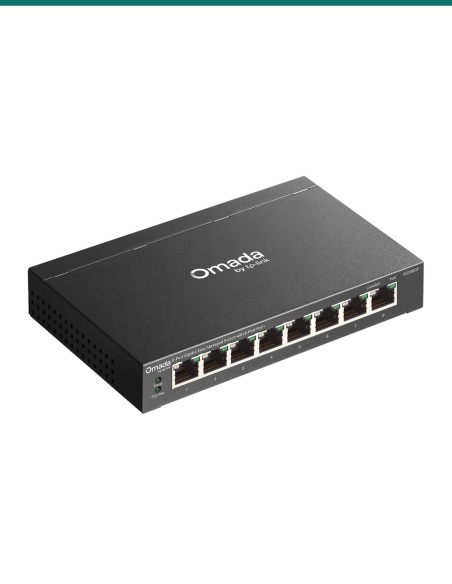
440 × 140 × 44 mm. Fit the brackets for a 19-inch cabinet, or stick on the rubber feet and stand it on a shelf. Logo artwork can differ between hardware versions; the switch is the same.
How it goes in
Racked and running in four steps.
01
Mount it
Screw the brackets to the sides and fix it in a 19-inch rack, or fit the rubber feet for a shelf. Keep the vents clear.
02
Set the switches
Leave Isolation and Loop Prevention off for a normal network, or turn them on as needed before you connect.
03
Connect the network
Patch the router or core switch into a port (use 15 or 16 if Isolation is on), then patch in computers, printers and other devices.
04
Power and check
Earth the grounding terminal if your rack is earthed, plug in the power cord and check the Power and port lights.
At a glance
DS1016G
Show specs
Ports
16 × 10/100/1000 Mbps RJ45, auto-negotiation and auto MDI/MDIX
Switching capacity
32 Gbps; 23.8 Mpps forwarding; store and forward
Isolation Mode
Ports 1–14 (ports 15–16 stay open as uplinks)
Loop Prevention
Ports 1–16
Other features
802.1p/DSCP QoS, Green Ethernet
Standards
IEEE 802.3i, 802.3u, 802.3ab, 802.3x, 802.1p
Network media
10BASE-T Cat3/4/5; 100BASE-TX and 1000BASE-T Cat5, Cat5e or better; 100 m
Management
Unmanaged, plug and play; not managed by Omada SDN
Power supply
Built in, 100–240 V AC, 50/60 Hz
Power use
10.68 W maximum; 36.31 BTU/h
Size and mounting
440 × 140 × 44 mm; 19-inch rack or desktop
Security
Kensington security slot (lock not included)
Operating range
0 °C to 40 °C; 10% to 90% RH non-condensing
Certification
CE, FCC, RoHS
Warranty
3 years, TP-Link Australia
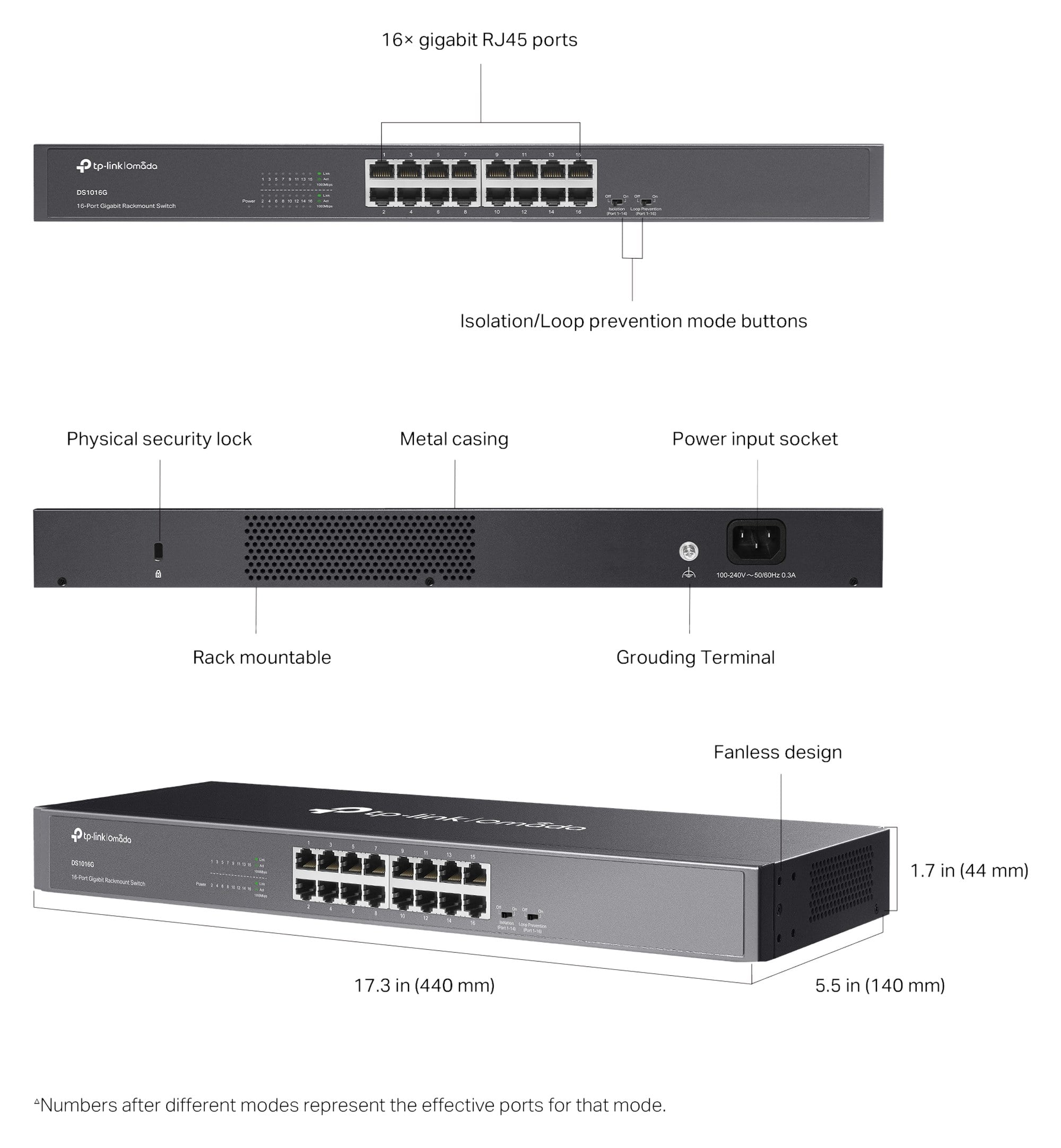
TP-Link's DS1016G drawing: 16 ports, mode switches, rear power socket, 440 × 140 × 44 mm.
Pair it with
What this switch works with
Power over Ethernet
A PoE switch
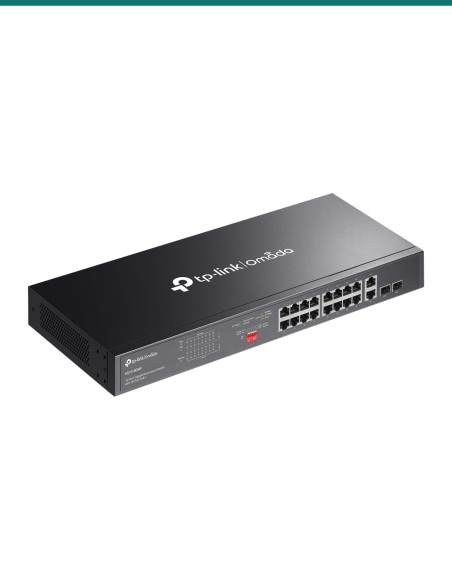
The DS1016G has no PoE. For cameras or access points, add a PoE switch such as the DS1018GMP.
Bigger site
DS1024G
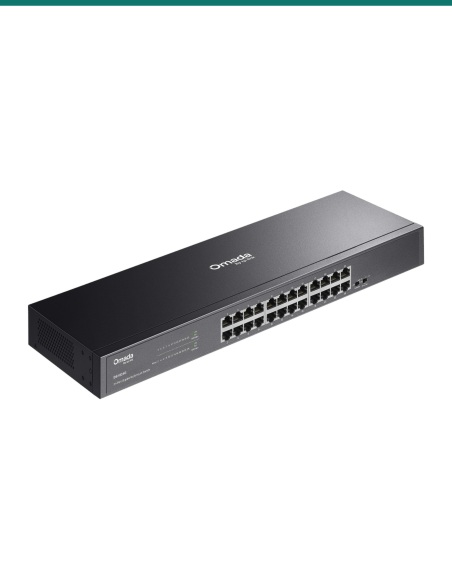
The same switch with 24 gigabit ports, for when 16 is not quite enough.
Cabling
Cat5e or Cat6 patch leads
Short leads from the patch panel to the switch, up to 100 m per run.
Cabinet
A 19-inch rack
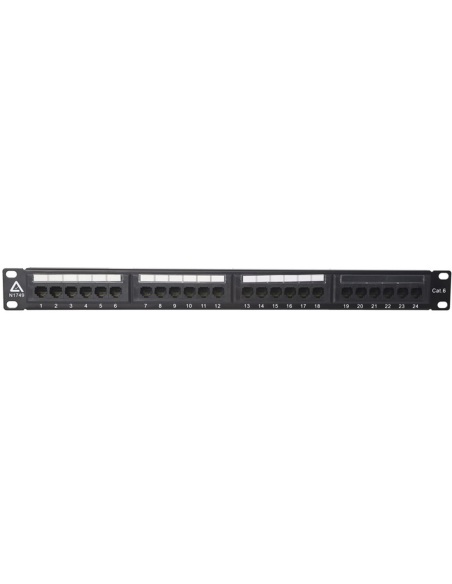
The brackets are in the box. Add a patch panel and cable management for a tidy install.
Where it is used
Where a 16-port gigabit switch fits.
Small offices
Desks, printers and the server patched into one silent rack unit.
Comms cabinets
Extra gigabit ports beside the router or NVR without fan noise.
Home networks
Every wired room patched back to one switch in the cupboard.
Shared offices
Isolation keeps tenants' ports apart while they share the internet uplink.
Classrooms and labs
Wired computers on one switch, with Loop Prevention guarding against stray cables.
Shops and clinics
Point-of-sale, printers and workstations on a plug-and-play switch.
DS1016G or DS1024G
| DS1016G (this switch) | DS1024G |
|---|
| Gigabit ports | 16 | 24 |
| Switching capacity | 32 Gbps | 48 Gbps |
| Forwarding rate | 23.8 Mpps | 35.7 Mpps |
| Isolation Mode | Ports 1–14 | Ports 1–22 |
| Loop Prevention | Ports 1–16 | Ports 1–24 |
| Maximum power use | 10.68 W | 13.62 W |
| Size | 440 × 140 × 44 mm | 440 × 140 × 44 mm |
From TP-Link's DS1016G and DS1024G datasheets (V1.20). Both are fanless, unmanaged and have a built-in power supply.
Common questions
How many ports does the DS1016G have?
16 gigabit RJ45 ports, each running at 10, 100 or 1000 Mbps with auto MDI/MDIX.
Does it have PoE?
No. It does not power cameras or access points. For that, choose a PoE switch such as the DS1018GMP.
Is it managed?
No. It is plug and play with no web page or VLAN setup, and it is not managed by Omada SDN.
What does Isolation mode do?
Ports 1 to 14 can no longer talk to each other, only to ports 15 and 16. Plug your router into 15 or 16 when it is on.
What does Loop Prevention do?
When it is on, the switch watches ports 1 to 16 for network loops, such as a cable plugged back into the network, and deals with them to stop the network grinding to a halt.
Is it noisy?
No. The DS1016G is fanless, so it is silent.
Is the power supply built in?
Yes. It runs from 100–240 V AC and TP-Link lists the power cord in the box.
Can it go in a rack?
Yes. The rackmount kit is in the box for a 19-inch rack. Rubber feet are included for a desk or shelf.
Does it have SFP or fibre ports?
No. All 16 ports are copper RJ45.
How much power does it use?
10.68 W at most, according to TP-Link's datasheet.
What is the difference from the DS1024G?
The DS1024G has 24 ports and 48 Gbps switching capacity in the same size case. Otherwise they work the same way.
Who can install the cable?
Concealed data cabling to outlets and devices is customer cabling under AS/CA S009 and needs an ACMA-registered cabler.
Supported by InFront Technologies.
Not sure whether you need 16 or 24 ports, or PoE? Call 1300 736 970 or email [email protected]. The datasheet is on the Attachments tab. 3-year TP-Link Australia warranty: contact us first and we will look after the claim.
Installation and safety
Mains powered. The switch plugs into a 100–240 V AC outlet with the supplied cord. A new power point needs a licensed electrician.
Cabling. Concealed data cabling is customer cabling under AS/CA S009 and needs an ACMA-registered cabler.
Ventilation. It is fanless, so keep the vents clear and keep it within 0 °C to 40 °C.
What it does not do. No PoE, no SFP or fibre ports, no VLAN setup, web interface or Omada SDN management.
Figures. From TP-Link's DS1016G datasheet (V1.20) and installation guide.